Lungora — Detailed Ingredient Profile & Scientific References
Lungora’s formula isn’t built around a single “hero” ingredient. Instead, it combines six well-documented nutrients and botanical extracts — Magnesium Glycinate, Alpha Lipoic Acid, Butcher’s Broom root extract, L-Carnitine, Turmeric extract, and Coenzyme Q10 (CoQ10) — chosen for how they work together across three complementary areas: nerve health, circulation and cellular energy, and antioxidant protection.
Rather than asking one compound to do everything, this multi-pathway approach reflects a broader idea in nutritional science: respiratory wellness and everyday vitality are influenced by several interconnected systems in the body, not just one. Below, we break down each ingredient individually — what it is, why it’s paired the way it is in Lungora’s formula, and the scientific research behind it, drawn from peer-reviewed studies, clinical trials, and systematic reviews.
A quick note before you dive in: the studies referenced below were conducted on these ingredients individually — often at specific doses, in specific forms, and in specific populations (people with diabetes, older adults, athletes, and so on). They help explain why each ingredient was selected, but they are not clinical trials of Lungora itself as a finished product, and results for any individual ingredient don’t guarantee the same effect from the complete formula. Where the evidence is mixed rather than uniformly positive, we’ve noted that too, so you can make an informed decision.
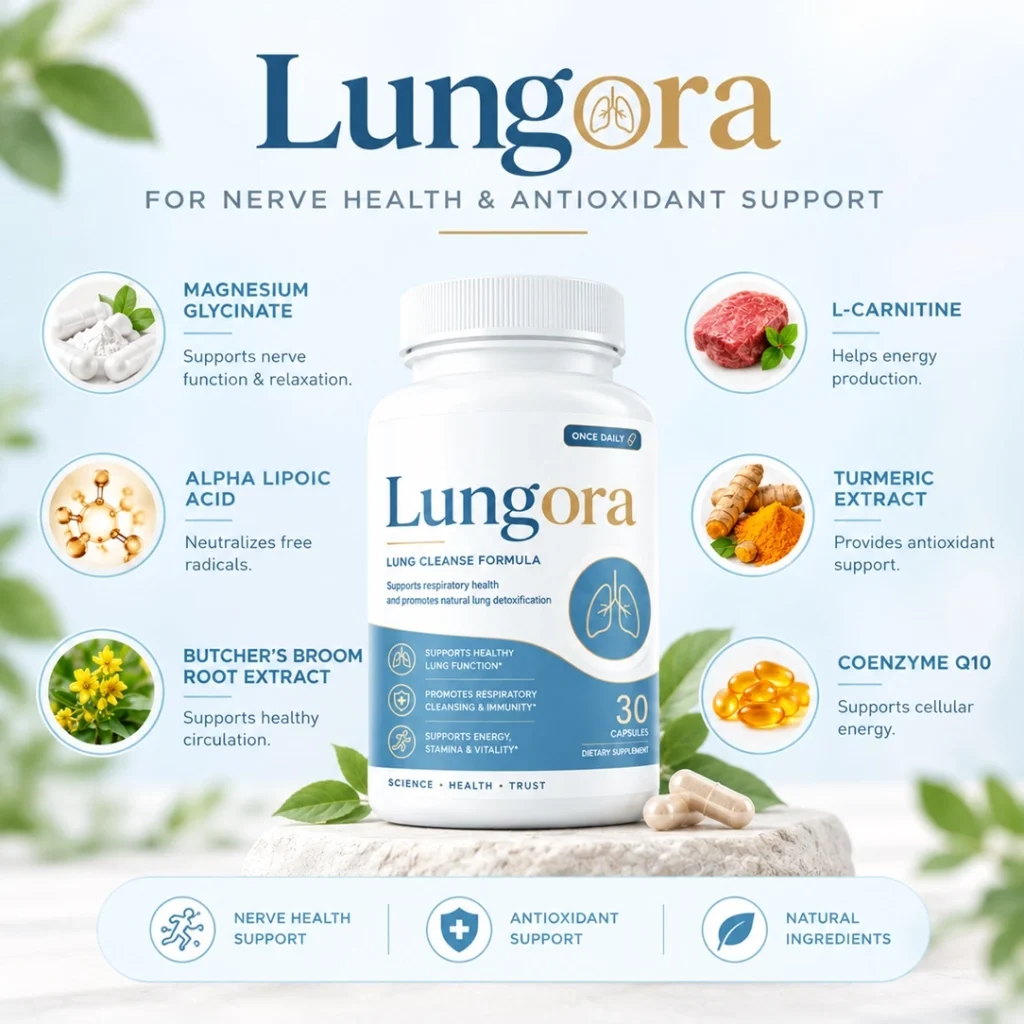
Lungora Ingredients List
1. Magnesium Glycinate
Role in the formula: Nerve health & muscle function support
Magnesium glycinate is magnesium bound to the amino acid glycine, a combination chosen for its high absorption and gentler effect on digestion compared to other magnesium salts. Magnesium is a cofactor in hundreds of enzymatic reactions, including those governing nerve signal transmission and muscle relaxation.
Supporting evidence:
- A cross-sectional study of nearly 1,000 people with type 2 diabetes found that lower serum magnesium levels were associated with measurably worse peripheral nerve conduction on nerve testing, supporting magnesium’s role in normal nerve function. nih
- Randomized, placebo-controlled trials from Brigham and Women’s Hospital are testing whether 480 mg/day of magnesium glycinate for 12 weeks lowers blood pressure in adults with elevated readings, reflecting magnesium’s studied role in vascular and circulatory function. clinicaltrialsclinicaltrials
- An animal study on chronic organic magnesium supplementation examined how different magnesium forms, including glycinate, affect brain, muscle, and vascular function over eight weeks, using tests of neuromuscular performance and cognitive/behavioral outcomes. nih
2. Alpha Lipoic Acid (ALA)
Role in the formula: Antioxidant & nerve support (paired with magnesium)
ALA is a naturally occurring, sulfur-containing compound often called a “universal antioxidant” because it is soluble in both water and fat, allowing it to act throughout the body rather than in one tissue type.
Supporting evidence:
- A systematic review and meta-analysis of 15 controlled trials found that ALA supplementation significantly reduced malondialdehyde, a key marker of oxidative cell damage, compared with placebo. ScienceDirect
- A large safety-focused meta-analysis pooling 71 clinical studies and nearly 4,750 participants reviewed ALA’s antioxidant and metabolic effects alongside its safety profile. nih
- A systematic review of ALA in diabetic neuropathy covering eight studies and around 1,500 patients evaluated whether ALA reduced neuropathic symptoms, one of the best-studied applications of ALA’s nerve-protective, antioxidant activity. nih
- Mechanistically, ALA is understood to act through multiple antioxidant pathways, including chelating metals and regenerating other antioxidants like vitamins C and E, which is the basis for its inclusion alongside magnesium in Lungora’s “nerve health” pairing. nih
3. Butcher’s Broom Root Extract (Ruscus aculeatus)
Role in the formula: Circulation support (paired with L-Carnitine)
Butcher’s broom is a Mediterranean shrub whose rhizome/root has a long history of traditional use for vein and circulatory support, and is one of the more clinically studied botanicals for venous tone.
Supporting evidence:
- A multi-center, double-blind, randomized, placebo-controlled trial in 166 women tested a Ruscus aculeatus extract against placebo over a 12-week period, measuring change in leg volume as the primary outcome. Unbound MedicinePubMed
- That trial found the extract significantly reduced leg volume and ankle/lower-leg circumference, while also easing subjective symptoms such as heaviness and tingling, findings that support its traditional use for circulatory and vascular tone. ResearchGate
- A broader pharmacological review notes butcher’s broom is typically combined with flavonoids such as hesperidin, and clinical trials, including at least one double-blind study, have supported this combination for chronic venous insufficiency. PeaceHealth
4. L-Carnitine
Role in the formula: Cellular energy support (paired with Butcher’s Broom)
L-Carnitine is an amino-acid derivative that shuttles fatty acids into the mitochondria — the cell’s energy-producing structures — for conversion into usable energy (ATP).
Supporting evidence:
- A randomized, double-blind, placebo-controlled trial in centenarians gave 2 g of L-carnitine daily and found significant reductions in physical fatigue, mental fatigue, and overall fatigue severity compared with placebo, alongside cognitive test improvements. PubMed
- A systematic review and meta-analysis focused on rehabilitation and healthy subjects reported that in older adults, L-carnitine reduces the sensation of fatigue and supports physical, mental, and cognitive function. PubMed Central
- A separate meta-analysis of L-carnitine and exercise found a statistically significant reduction in blood lactate, a marker linked to muscular fatigue, consistent with its role in energy metabolism. Acta Biomedica Atenei Parmensis
5. Turmeric Extract (95% Curcuminoids)
Role in the formula: Antioxidant & anti-inflammatory support (paired with CoQ10)
Curcumin is the primary bioactive compound in turmeric root, and Lungora uses an extract standardized to 95% curcuminoids for a more concentrated, consistent dose than raw turmeric spice.
Supporting evidence:
- A GRADE-assessed systematic review and dose-response meta-analysis of randomized controlled trials found that turmeric/curcumin supplementation significantly reduced inflammatory markers such as CRP, TNF-α, and IL-6, while also improving antioxidant markers including total antioxidant capacity and superoxide dismutase activity. PubMed
- A comprehensive review of curcumin’s biological activity describes demonstrated anti-inflammatory, antioxidant, and antimicrobial effects across in vitro and in vivo research, while also flagging curcumin’s characteristically low natural bioavailability as an ongoing research challenge. nih
- Historically, turmeric has been used in traditional medicine specifically for respiratory conditions, alongside abdominal pain, rheumatism, and inflammation — relevant context for why it appears in a respiratory-wellness formula. nih
6. Coenzyme Q10 (CoQ10)
Role in the formula: Cellular energy & antioxidant support (paired with turmeric)
CoQ10 is a naturally occurring compound found in every cell, where it plays a dual role: shuttling electrons in the mitochondrial energy chain, and acting as a fat-soluble antioxidant. Natural CoQ10 production tends to decline with age.
Supporting evidence:
- A double-blind, randomized, placebo-controlled trial in older adults with statin-associated fatigue tested 300 mg/day of a CoQ10 phytosome formulation and measured its effect on physical performance markers like handgrip strength and step tests. nih
- A randomized controlled trial in adults aged 65–75 combined CoQ10 supplementation with an 8-week high-intensity interval training program and found significantly greater improvements in chair-stand strength tests versus placebo. nih
- Mechanistically, CoQ10 is described as a fat-soluble molecule central to the mitochondrial electron transport chain, carrying electrons between Complex I/II and Complex III — the core energy-production pathway CoQ10 supplementation is intended to support. nih
- Not all findings are uniformly positive: one 12-week randomized trial in community-dwelling older adults found that 400 mg/day of CoQ10 raised blood plasma levels of CoQ10 but did not measurably improve mitochondrial function in muscle biopsies — a useful reminder that evidence on CoQ10’s functional benefits in aging is still mixed. KuPubMed
How They Work Together
Individually, each of Lungora’s six ingredients has its own body of research behind it. But the formula isn’t designed to be read as six separate items — it’s built as three deliberate pairs, each aimed at a different system that contributes to how comfortably you breathe, move, and feel day to day.
🌿 Magnesium Glycinate + Alpha Lipoic Acid — Nerve Health
Magnesium supports the electrical signaling that lets nerves communicate normally, while ALA’s dual water- and fat-soluble antioxidant activity helps protect those same nerve pathways from oxidative stress. Paired together, one supports the signal, the other helps protect the wiring it travels through.
🌿 Butcher’s Broom + L-Carnitine — Circulation & Cellular Energy
Butcher’s Broom is traditionally used to support venous tone and healthy circulation, while L-Carnitine’s job is to shuttle fatty acids into mitochondria so cells can convert them into usable energy. The logic here is sequential: better circulation supports the delivery of oxygen and nutrients to tissue, while L-Carnitine supports what those tissues do with the fuel once it arrives.
🌿 Turmeric Extract + CoQ10 — Antioxidant & Cellular Protection
Curcumin (from turmeric) and CoQ10 are both well-studied antioxidants, but they tend to work in different parts of the cell — curcumin is known for modulating inflammatory signaling broadly, while CoQ10 operates specifically within the mitochondrial electron transport chain, the same energy-producing machinery L-Carnitine feeds into. Together, they’re intended to guard cellular function from two different angles rather than one.
Why pair ingredients instead of relying on one?
The underlying premise is that respiratory wellness and everyday vitality aren’t governed by a single mechanism — they’re influenced by an interplay of nerve signaling, circulation, cellular energy output, and how well the body defends its cells against oxidative damage as it ages. Rather than concentrating the entire formula on one pathway (for example, antioxidants alone), Lungora spreads its six ingredients across all three areas, on the premise that addressing them together may offer broader support than addressing any one in isolation.
It’s worth being direct about the limits of this reasoning: the pairings are grounded in each ingredient’s individual research and their complementary mechanisms of action, not in a clinical trial testing this exact six-ingredient combination as a finished product. The scientific literature supports what each compound does on its own; it doesn’t yet tell us precisely how much added benefit comes from combining them in these specific pairs. As always, Lungora is a nutritional supplement intended to support overall wellness — not a treatment for any diagnosed condition — and individual results will vary.
Are you ready for healthy breath?
Join thousands of adults over 50 who have made Lungora part of their daily wellness routine.